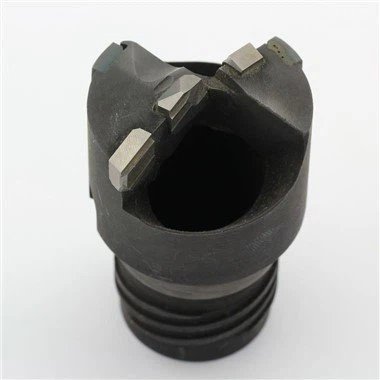
Wie kann man die Drift der Tieflochbearbeitung lösen?
Nov 01, 2021
Bei der Tieflochbearbeitung wird es aufgrund des Symmetriefehlers der beiden Schneidkanten des Bohrers und der Inkonsistenz der Schärfe usw. zu einer Verschiebung der Lochposition während des Bohrvorgangs kommen. Unter normalen Umständen ist es schwierig, den Driftwert von 100 mm innerhalb von 0,1 mm zu kontrollieren. Im Allgemeinen werden die anspruchsvolleren Löcher nach dem Bohren aufgebohrt. Reiben kann die Durchmessergenauigkeit des Lochs steuern und die Oberflächenqualität verbessern. Aber es kann die Drift, die durch das Bohren verursacht wird, nicht korrigieren.
Um dieses Problem zu lösen, brachen wir mit dem konventionellen Denken und glaubten, dass, obwohl die Drift während des Bohrens unvermeidlich ist, die Koaxialitätsanforderung immer noch sichergestellt werden kann, indem der äußere Kreis an das innere Loch angepasst wird. Die spezifischen Prozessschritte der Lochpositionsdriftlösung für die Tieflochbearbeitung sind:
(1) Blanking, lassen Sie einen Rand von 2 mm für die Gesamtlänge.
(2) The left end of the car is exposed to light, and the outer circle of the rough car is φ35.5mm.
(3) Clamp the outer circle that has been rough-turned at the left end, and finish turning the right end face to ensure that the total length is 80±0.05 mm, and drill and ream through holes of φ4.9±0.05 mm.
(4) Remove the burrs at the two ends of the hole, two holes with φ4.9±0.05 mm, and the outer circle of φ34.9 mm is finely turned.
(5) Then process the remaining dimensions based on the outer circle of φ34.9 mm.
In this way, the φ4.9±0.05 mm hole is processed first, and then the other dimensions are processed on the basis of the φ4.9±0.05 mm hole, so that the drift error during the processing of the φ4.9±0.05 mm hole will be used in the subsequent processing Be corrected.